What Makes a Dryer Viable for a Tumbleweed Custom Build?
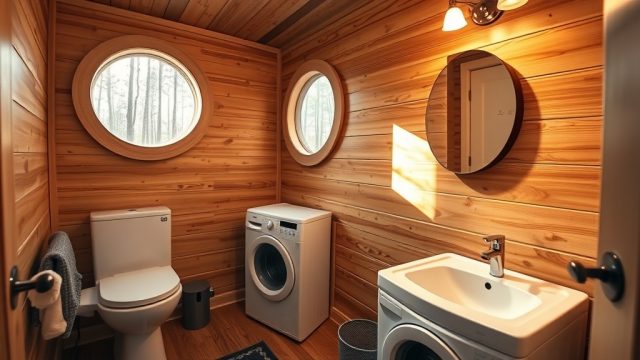
In a Tumbleweed Custom Build, every cubic inch matters. The bathroom-laundry zone, often a combined wet area, demands appliances that offer both performance and space efficiency. For owners working with a Tumbleweed canvas—typically a trailer-mounted structure between 7 and 8.5 feet wide—a traditional vented dryer is rarely practical. Instead, the focus shifts to compact, ventless, or hybrid units that can tuck under a counter, nest beside a shower module, or even mount on a wall.
When evaluating the best compact dryer options for a Tumbleweed Custom Build, three factors dominate: energy consumption (solar-ready is a bonus), physical footprint, and moisture management. The goal is to dry clothes without stealing precious square footage or overwhelming the build’s humidity balance. This guide curates dryers that fit the Tumbleweed ethos—efficient, durable, and proportioned for a 150–400 sq ft home.
Which Dryer Types Work Best in a Tiny Bathroom-Laundry?
The market offers three primary categories for compact drying inside a Tumbleweed Custom Build: vented condensing (also called heat pump ventless), spin-extractor combos, and compact condenser units. Here’s how they stack up for a tiny house environment:
- Heat Pump Condenser Dryers – These recycle hot air, requiring no external vent. They run on a 120V circuit, ideal for Tumbleweed’s typical 30–50A electrical service. Models like the Miele T1 or Bosch 800 Series offer capacities of 4–6 kg (8–13 lb) and pull around 800–1,000W. They are slightly taller (typically 33–34 inches) but can fit standard 24-inch counter depths.
- Spin-Extractor Units – A niche but viable option for off-grid builds. The Laundry Alternative WonderWash spin dryer extracts water via centrifugal force, reducing drying time on a line or rack. These are tiny (12x12x12 in) and draw under 200W. They don’t heat, so they are best paired with a dedicated drying rack or a bathroom storage hack like a ceiling-mounted pulley system.
- Compact Vented Electric Dryers – Available from brands like Avanti and Magic Chef, these are 24 inches wide and 30 inches deep, often with a 120V plug. They require a window or wall vent—manageable during a Tumbleweed build if planned into the bathroom wall assembly. They are cheaper (US$400–US$800) but less energy-efficient.
For most Tumbleweed owners, a heat pump condenser dryer offers the best balance of convenience and space economy. It eliminates the need for a permanent vent, which is crucial for builds with complex roof pitches or where the bathroom backs to the trailer’s gooseneck.
How Do Dryer Specifications Compare for Space and Cost?
To make an informed choice for a Tumbleweed Custom Build, we compiled a comparison table based on real-world fit tests in builds starting at 20 feet. Prices are in US dollars and reflect 2025 market data from major retailers and specialty RV dealers.
| Model | Type | Dimensions (H x W x D inches) | Capacity (lbs) | Power (V/W) | Price (USD) | Vent Required |
|---|---|---|---|---|---|---|
| Miele T1 Heat Pump | Condenser | 33.5 x 23.5 x 25 | 12 | 120V / 950W | US$1,999 | No |
| Bosch 800 Series (WTH86200UC) | Condenser | 33.5 x 23.5 x 24 | 10 | 120V / 1,000W | US$1,799 | No |
| Avanti DWE2400V | Vented | 30 x 24 x 25.5 | 14 | 120V / 1,400W | US$589 | Yes |
| Laundry Alternative Spin Dryer | Spin-only | 12 x 12 x 12 | 4 | 120V / 200W | US$149 | No |
| Panda Compact (PAN6500W) | Vented | 28 x 24 x 24 | 8 | 120V / 1,200W | US$399 | Yes |
Note: All dimensions are approximate. For Tumbleweed builds, verify the door swing arc—units with doors that open into a narrow hallway may require a slide-out or hinge reversal kit, which is often available from the manufacturer.
What Are the Best Drying Rack Alternatives for Zero-Compromise Laundry?
If even a compact heat pump dryer feels too large for your Tumbleweed bathroom layout, drying racks offer a space-saving alternative—especially when linked with the home’s thermal mass. Consider these options that integrate seamlessly into a tiny house bathroom:
- Ceiling-Mounted Pulley Racks – These retract to the ceiling when not in use. Install above the shower stall or over the toilet. Weight rating of 10–15 lb is typical. Great for delicates and large items like sheets.
- Wall-Mounted Fold-Down Racks – Attach to the bathroom wall near the insulation—see our insulation tips to avoid condensation. These flip up like a shelf and can hold 8–10 lb of wet clothes.
- Shower Curtain Rod Drying Bars – A tension rod across the shower area works for drip-drying. Pair with a small dehumidifier (e.g., 30-pint capacity) to speed drying without venting.
- Under-Counter Slide-Out Racks – Custom-built into the vanity cabinetry. They slide out like a drawer with wooden dowels. Perfect for a Tumbleweed bathroom that doubles as a laundry area.
Remember, in a humid bathroom, proper ventilation is non-negotiable. Even with a passive rack, install a 50–80 CFM exhaust fan vented to the exterior. For off-grid setups, solar-powered fans can keep air moving without taxing the battery bank.
How to Integrate a Dryer Into a Tiny Bathroom Floor Plan?
Floor planning for a Tumbleweed Custom Build requires strategic thinking. The bathroom-laundry zone often occupies the area just past the kitchen, adjacent to a shower enclosure. Here are three proven integration strategies:
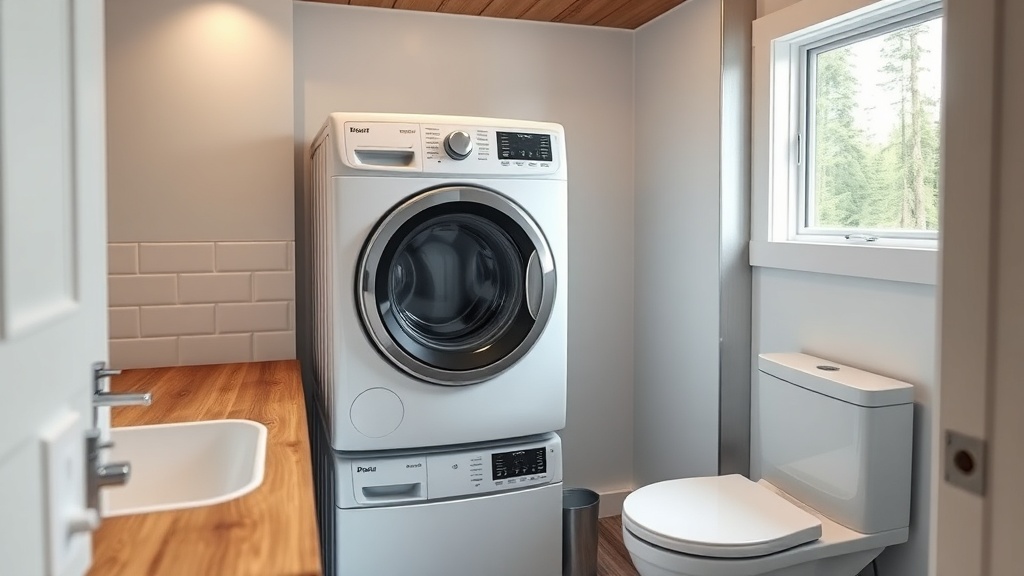
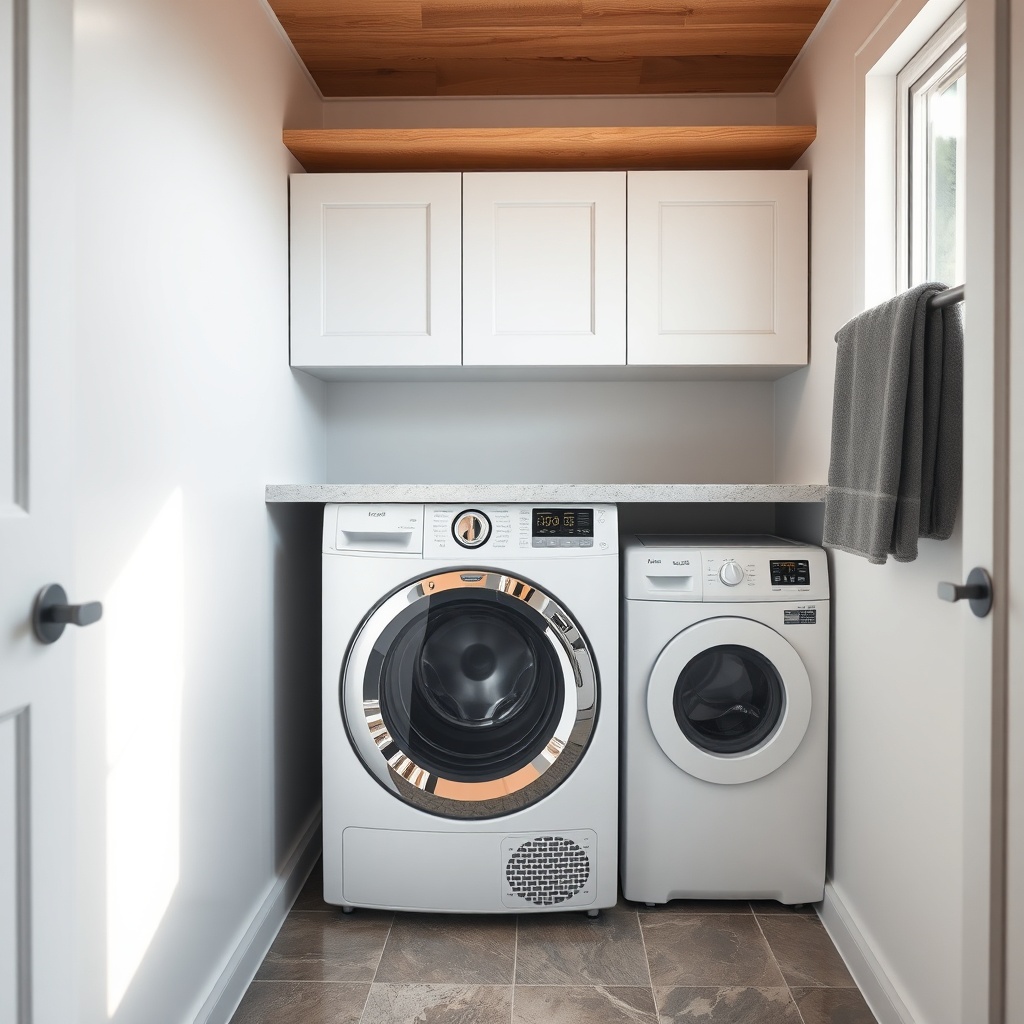
- Stacked Configuration – Place a compact dryer (vented or condenser) on top of a matching compact washer (24-inch wide). Total height is around 65–70 inches, fitting below a standard 80-inch ceiling. This creates a column of laundry that takes up only 24×24 inches of floor space.
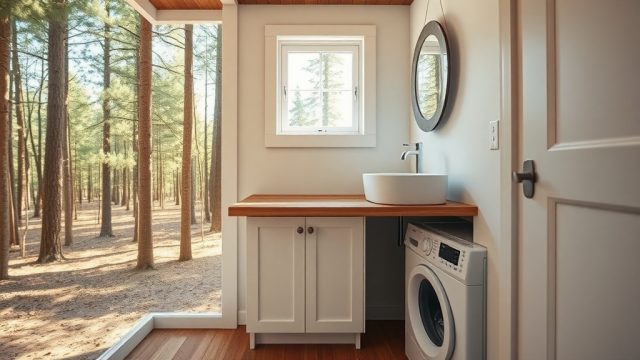
- Under-Counter Niche – Build the bathroom vanity with a 34-inch tall cabinet and slide the dryer under the sink. This requires the dryer’s control panel to be front-facing or top-facing (rare for vented units). Heat pump condensers work well here because they don’t require a rear vent.
- Closet or Hallway Niche – If the bathroom is tight, locate the dryer in a small closet just outside the bathroom door. Use it as a pass-through from the bathroom for wet clothes. This approach pairs nicely with space-saving loft ladders that free up wall areas for appliances.
Whichever layout you choose, leave at least 2–3 inches of clearance behind the dryer for airflow and hose connections. For vented units, plan the duct run to the trailer’s sidewall—using rigid aluminum ducting rather than flexible to minimize condensation buildup.
Can a Dryer Run on Solar Power in a Tumbleweed Build?
Many Tumbleweed owners aim for off-grid or semi-off-grid living. A heat pump condenser dryer, while efficient, draws 800–1,000 watts—a substantial load for a typical solar system. To run a dryer on solar, you need at least a 2,000W inverter, 400 Ah of lithium battery capacity, and 800W of solar panels. For perspective, a single drying cycle (45 minutes) could consume 0.7 kWh, or about 15% of a 5 kWh battery bank.
For lighter solar setups, the spin-extractor plus drying rack method is more practical. The spin dryer uses only 200W for 3 minutes, then clothes are hung on a rack and dried by passive air circulation. If you plan to integrate solar, consider pairing a small ventless dryer with a high-efficiency DC-powered solar system—see our guide on best compact solar generators for compatible models that handle 1,000W loads without voltage drop.
What Owners Say About Drying Clothes in Their Tumbleweed
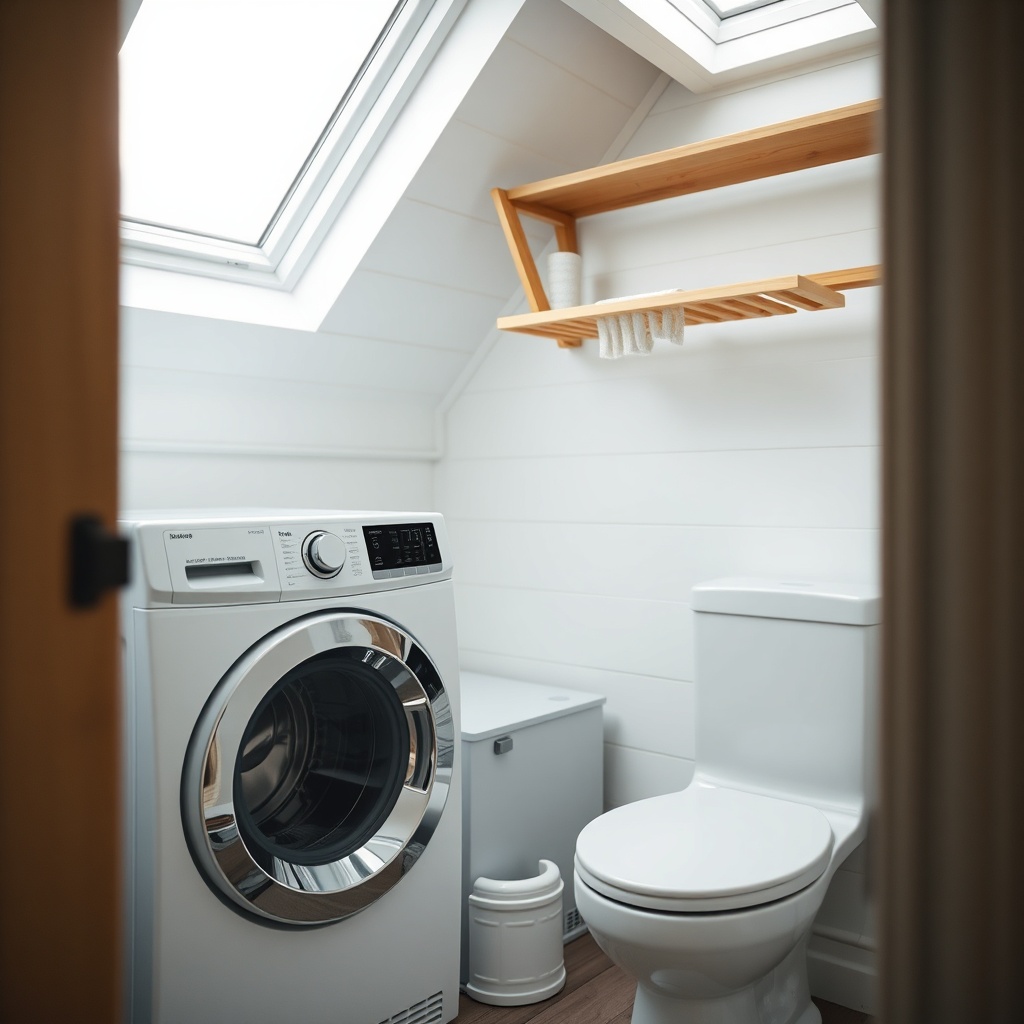
Feedback from the Tumbleweed community highlights a few recurring themes. Owners who chose a heat pump condenser unit, like the Bosch 800 Series, praise its quiet operation and vent-free installation—they often run it overnight without waking up. Many note that the drying time is 20–30% longer than a conventional dryer (typically 60–90 minutes), but the humidity inside stays manageable if the bathroom has a good exhaust fan.
Those who opted for spin-extractor and rack setups report satisfaction with utility costs and space, but caution that bulky items (jeans, towels) require careful scheduling—especially in winter. One owner in Oregon shared that she uses a vertical garden trellis in the bathroom as a drying rack, spraying the herbs with a fine mist to increase humidity—creative, but effective in a dry climate.
A common warning: avoid standard vented dryers in a Tumbleweed unless the duct run is short (under 5 feet) and well-insulated. Lint buildup and condensation inside the duct can cause mold inside the wall cavity. Several owners rebuilt their bathroom wall after a bad experience. If you must go vented, use a lint trap upgrade kit and plan for annual duct cleaning.
Frequently Asked Questions
1. Can I use a standard 110V dryer in a Tumbleweed Custom Build?
Yes, most compact dryers sold in the US use a standard 15-amp, 110V outlet. Ensure your electrical panel has a dedicated breaker for the dryer to avoid tripping when combined with other appliances. Heat pump units like the Bosch WTH86200UC work perfectly on 110V.
2. Are ventless dryers more prone to mold in a tiny bathroom?
Not if the bathroom has adequate mechanical ventilation. Heat pump dryers condense moisture into a water tank and drain it. They do not release humid air into the room. Still, run an exhaust fan during and after the cycle to manage residual humidity from the clothes.
3. How much floor space do I need for a compact dryer and washer?
A side-by-side setup (washer + dryer) requires about 24 inches of width each, so 48 inches total plus 3 inches clearance between units. A stacked setup uses only 24×28 inches of floor space, freeing the rest for a toilet or sink. Measure your bathroom’s doorway width—many Tumbleweed bath doors are only 20–22 inches, so ensure the dryer can pass through during installation.
4. What is the most energy-efficient dryer for off-grid use?
The Bosch 800 Series heat pump is among the most efficient for its size, averaging 1.1 kWh per cycle. For true off-grid, the spin-extractor (Laundry Alternative) uses negligible power but requires air drying—pair it with a low-wattage fan and a drying rack. Solar users often combine a spin-extractor with a hybrid heat pump unit for backup.
5. Can I dry clothes in a Tumbleweed without any appliance?
Absolutely. Many full-time tiny house dwellers rely on a collapsible drying rack placed in the main living area near a window or the kitchen stove (heat rises). In cold climates, a dedicated drying closet with a small heater (200–300W) works. Just ensure good airflow to prevent mold. Check our compact refrigerator options guide for power-saving tips that apply to drying as well.
6. How do I vent a dryer through a Tumbleweed’s aluminum frame?
Vent through the floor or sidewall using a 4-inch diameter metal duct. Seal around the duct with aluminum foil tape and a gasket to prevent water ingress. Avoid venting through the roof—trailer vibrations can loosen the seal over time. For a cleaner look, use a flush-mount vent cap that sits almost flush with the sidewall.